
An undocumented check is, in an inspector’s eyes, a check that didn’t happen.
A splash of disinfectant or etchant to the eye takes a fraction of a second. What happens in the next ten seconds can determine whether that employee walks away with temporary irritation or permanent vision loss. That’s why emergency eyewash equipment is one of the most frequently cited, and most frequently misunderstood, safety requirements in medical and dental offices.
In Nevada, eyewash requirements carry more weight than in many states. Since April 11, 2022, Nevada OSHA has enforced ANSI Z358.1-2014 as state regulation. Yet many practices are still relying on a squeeze bottle in a drawer or a faucet attachment nobody has tested in years.
The Regulatory Picture
Federal OSHA’s rule is short. Under 29 CFR 1910.151(c), wherever an employee’s eyes or body may be exposed to injurious corrosive materials, the employer must provide “suitable facilities for quick drenching or flushing” within the work area for immediate emergency use. The federal rule never defines “suitable.”
Nevada filled that gap. Through regulation R069-20, Nevada OSHA adopted ANSI Z358.1-2014 by reference, effective April 11, 2022. In its October 5, 2022 guidance to Nevada businesses, Nevada OSHA explained that the ANSI standard now sets the minimum design and installation criteria for what counts as a suitable facility, and that the adoption added new employee training requirements.
That guidance also spells out how Nevada OSHA cites violations:
No eyewash where one is needed: cited under 29 CFR 1910.151(c), generally as Serious. Need is determined from the chemical’s SDS and label.
Eyewash installed, but not suitable under ANSI Z358.1-2014 (installation, performance, or location): cited under R069-20, as Other-than-Serious or Serious depending on the likely outcome of an exposure.
No HAZCOM training for employees exposed to corrosive chemicals: cited under 29 CFR 1910.1200(h)(1), generally as Serious.
HAZCOM training that doesn’t cover the location and use of the eyewash: cited under R069-20.
That last point catches many offices. Your HAZCOM training must specifically teach employees where the eyewash is and how to use it.
Dental offices face an additional layer of scrutiny. The Nevada State Board of Dental Examiners has announced it will inspect dental offices for infection control and workplace safety, and eyewash readiness is an item an inspector can check in seconds.
Does Your Facility Need an Eyewash Station?
Nevada OSHA requires employers to review the SDS and label for every chemical before it’s introduced into the workplace. According to Nevada OSHA’s guidance, the following indicate that an eyewash station is required:
SDS hazard classification of Skin Corrosion Category 1, which includes a pH of 2 or less or 11.5 or greater
The signal word “DANGER” for highly corrosive substances
The corrosion pictogram with hazard statements such as “Causes severe skin burns and eye damage” or “Causes serious eye damage”
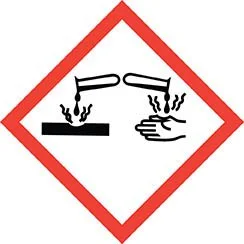
[Insert GHS corrosion pictogram]
The GHS corrosion pictogram.
If you see this on a label or SDS, evaluate the need for an eyewash.
Products commonly found in healthcare settings that may trigger the requirement include:
High-level disinfectants such as glutaraldehyde, ortho-phthalaldehyde (OPA), and peracetic acid
Concentrated bleach and sodium hypochlorite solutions, including endodontic irrigants
Phosphoric acid etchants used in dentistry
Concentrated instrument cleaners and ultrasonic solutions
Formalin and other formaldehyde solutions
Formaldehyde has its own rules. OSHA’s formaldehyde standard requires acceptable eyewash facilities within the immediate work area if there is any possibility that an employee’s eyes may be splashed with solutions containing 0.1% or more formaldehyde (29 CFR 1910.1048(i)(3)). That includes the 10% neutral buffered formalin in prefilled biopsy specimen containers, which is roughly 4% formaldehyde, well over the threshold. The same standard also requires conveniently located quick drench showers where employees’ skin may become splashed with solutions containing 1% or more formaldehyde, for example because of equipment failure or improper work practices (29 CFR 1910.1048(i)(2)).
A working eyewash also supports bloodborne pathogens compliance, which requires employees to flush mucous membranes with water immediately, or as soon as feasible, after contact with blood or other potentially infectious materials.
What a Compliant Eyewash Station Looks Like
Location and access. Nevada OSHA’s guidance states that it should never take longer than 10 seconds to reach the equipment and begin flushing, and recognizes a distance of no more than 55 feet as meeting that requirement. For highly corrosive chemicals, nothing can stand between the hazard and the station. Nevada OSHA specifically lists doorways, storage racks, boxes and loose work materials, and railings or other barriers as obstructions.
Safe placement. Nevada OSHA also directs employers to consider what happens when the unit is used: flushing water shouldn’t reach nearby electrical equipment, and the location should let the employee get a safe distance from an ongoing chemical hazard.
One-step activation. The control valve must go from off to on in one second or less and stay open without the user holding it, leaving both hands free to hold the eyelids open. A single paddle push is the standard design.
Flow and duration. The unit must deliver at least 0.4 gallons (1.5 liters) per minute for a full 15 minutes, in a controlled flow gentle enough not to injure the eye. Both nozzles must deliver adequate, even flow. One strong stream and one weak stream means one eye isn’t being properly flushed.
Water temperature. Flushing fluid must be tepid, between 60°F and 100°F, to promote at least 15 minutes of continuous flushing. Nevada OSHA’s guidance states plainly that stations not meeting this range are deemed unsuitable.
Height and clearance. The flushing outlets must be between 33 and 53 inches from the floor and at least 6 inches from the nearest wall or nearest obstruction, such as a cabinet.
Dust covers. Nozzles must be protected from airborne contaminants. On units designed with dust covers, both covers must be in place, and they should pop off automatically when the unit is activated.
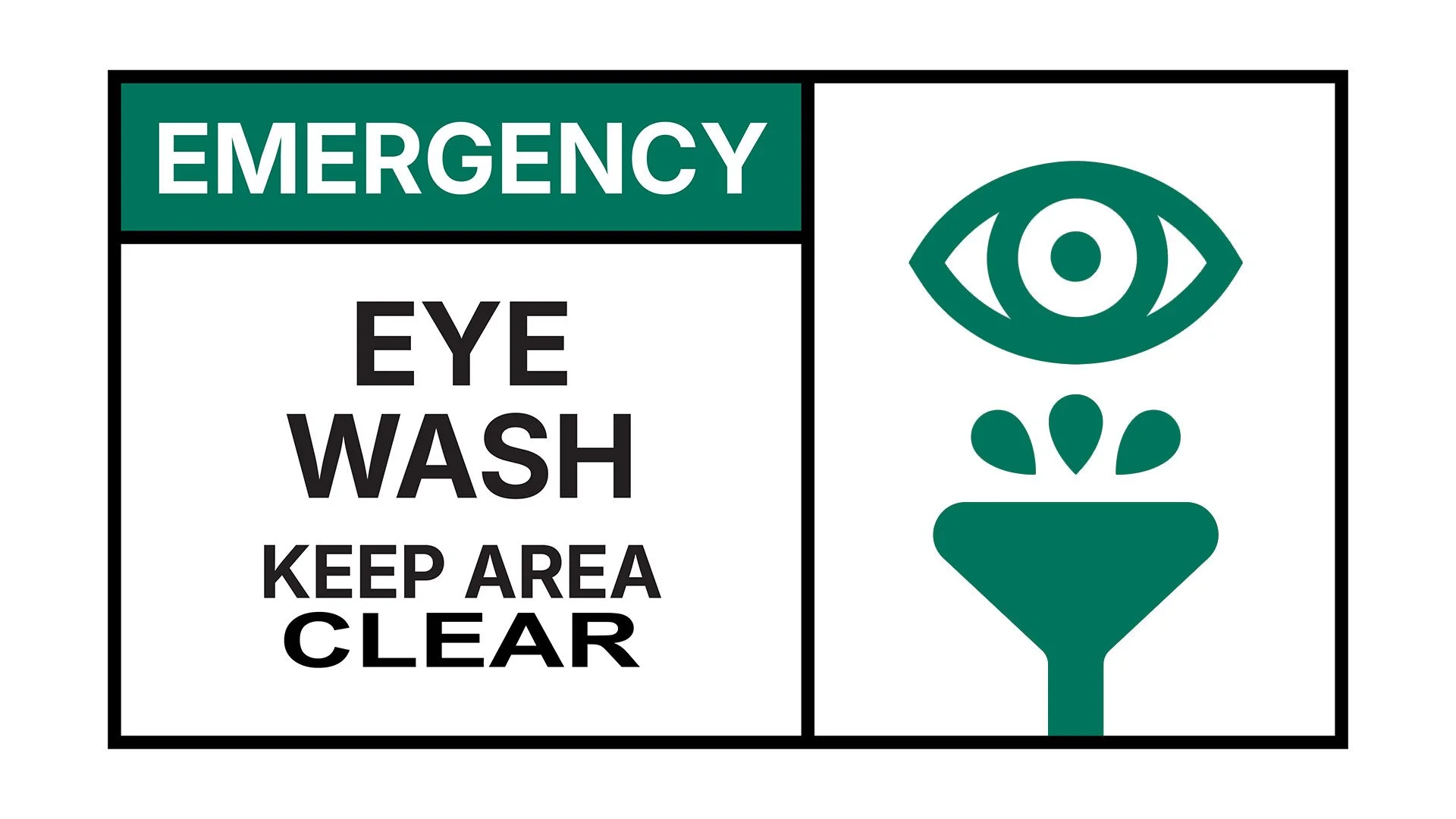
Visibility. The area must be well lit and marked with a highly visible sign.
Faucet-Mounted Units: Where Most Offices Get Into Trouble
Faucet-mounted eyewash units are common in medical and dental offices because they’re inexpensive and fit existing sinks. They can be compliant, but several details matter.
Two-step units. Many faucet-mounted models require turning on the faucet and then pulling a pin or diverter to start the flow. Nevada OSHA addressed these directly:
New installations of two-step units are considered non-compliant, and citations may be issued.
Pre-existing two-step units may be treated as a de minimis violation, but only if the employer has trained employees on their proper use and continues training on an ongoing basis.
Nevada OSHA strongly encourages employers to progressively replace two-step units.
If you’re buying or replacing a unit, choose a single-paddle design.
The sink. In most offices, the eyewash ends up on a hand hygiene sink. That sink needs warm water for hand hygiene anyway, so a unit plumbed to cold water only is a problem on two fronts. A faucet-mounted unit can be connected to both hot and cold water, provided the faucet is set so the water is tepid and staff are trained to keep it in the tepid range during use.
Never on the instrument processing sink. AAMI’s sterilization guidance (ANSI/AAMI ST79, §3.3.7) states that eyewash stations should not be located where an employee would have to flush their eyes in a decontamination sink. Splashing water from a sink used for contaminated instruments toward an injured employee’s eyes defeats the purpose of flushing. That doesn’t mean the sterilization area goes without: ST79 also calls for eyewash access within 10 seconds wherever corrosive chemicals are used. The eyewash belongs at a clean sink.
What if there’s only one sink? Most outpatient reprocessing areas have a single sink, and it’s the one used for instrument cleaning. The good news is that medical and dental offices are compact, typically under 1,800 square feet and rarely more than 3,000, so a clean hand hygiene sink in a nearby operatory, lab, or breakroom is almost always within the 10-second requirement. Choose the closest one, keep the path clear, and when corrosive chemicals are involved, make sure no door stands between the hazard and the eyewash. Avoid restrooms, since the door can be locked or occupied.
Certification. The unit should be certified to ANSI Z358.1.
Wall-Mounted Bottles Are Not Eyewash Stations
Personal eyewash bottles, including the wall-mounted kind, do not meet the requirement on their own. Most deliver a single stream that can flush only one eye at a time, and none can supply 15 minutes of continuous flow. ANSI classifies them as supplemental equipment: useful for immediate flushing on the way to a compliant station, but never a replacement for one. AAMI ST79 is equally direct, stating that eyewash bottles are not acceptable emergency eyewash units and that units must flush both eyes at the same time.
Hard Water: A Nevada-Specific Problem
Much of Nevada, particularly southern Nevada, has very hard water. Over time, mineral and calcium deposits build up inside eyewash units, causing two common failures:
The paddle or activation valve sticks or becomes stiff, slowing activation beyond the one-second requirement
One nozzle puts out adequate flow while the other is reduced or blocked
Weekly activation helps slow buildup, but it doesn’t prevent it. An annual performance test is the only way to confirm both nozzles still deliver the required flow. If you’re already a Compliance Alliance client, we perform this testing for you during your annual Assessment of Hazards.
Inspection, Documentation, and Training
Weekly. Plumbed units must be activated at least weekly to verify operation and confirm flushing fluid is available. This also clears stagnant water from the line, which can harbor bacteria such as Acanthamoeba and Legionella. Self-contained units must be inspected weekly to determine whether fluid needs to be changed or added, following the manufacturer’s instructions exactly.
Annually. All units must be inspected annually for compliance with the installation provisions of ANSI Z358.1-2014.
Nevada OSHA’s guidance is blunt on this point: stations that are not inspected on a weekly and annual basis are deemed unsuitable facilities.
Documentation. Nevada OSHA highly recommends documenting every inspection with at least a checklist, the employee’s name, and the date, and recommends documenting water temperature verification as part of those checks. An undocumented check is, in an inspector’s eyes, a check that didn’t happen.
Training. ANSI Z358.1-2014 requires that employees know where the nearest eyewash is and how to use it, and in Nevada that content must be part of your HAZCOM training. Employees must receive this training at the point of hire and should be retrained at least annually thereafter, as well as whenever a new hazardous product is introduced. Good training covers activating the unit with eyes closed, adjusting water to tepid if the unit is plumbed to hot and cold, holding the eyelids open, and flushing for a full 15 minutes before seeking medical care.
Common Gaps We See in Nevada Offices
Squeeze bottles or wall-mounted bottles used as the only eyewash
Two-step faucet units with no documented, ongoing training, or newly installed two-step units
Units connected to cold water only, often on a hand hygiene sink that should have warm water
Eyewash mounted on the instrument processing sink in the reprocessing area
One or both dust covers missing
Calcium buildup causing a sticky paddle or uneven flow between nozzles
Stations blocked by supply carts, trash cans, doors, or storage
No weekly log, or a log with months of gaps
HAZCOM training that never mentions the eyewash
New products introduced without an SDS review
Get Ahead of Your Inspection
Nevada’s eyewash requirements have been enforceable since 2022, and with NSBDE inspections underway for dental offices, now is the time to verify your setup. Compliance Alliance performs annual eyewash testing to ANSI Z358.1-2014 and provides the documentation systems your office needs to record weekly activations and inspections, so you’re ready when the inspector arrives. Request an evaluation here.